The Q4 Scramble: What Your Pipeline Actually Looks Like on September 29

by Dave Doherty, growth[period] Strategic Client Advisor

As the final days of the calendar year approach, federal business development and capture teams confront a high-friction procurement window. On September 29, the traditional start of the calendar year’s fourth quarter (Q4 CY) is just two days away. However, in the context of federal contracting, this calendar milestone aligns with the absolute opening frame of the US Government Fiscal Year 2027 (FY27), which commences on October 1.

Navigating this overlapping timeline requires strict operational precision because the pipeline seen on paper rarely matches the contractual realities on the street. The start of the government fiscal year is almost universally constrained by a Continuing Resolution (CR). For a business development professional, a CR creates an immediate disconnect between high-value procurement targets and achievable contract signings. Because a CR imposes a strict statutory ban on new starts and caps spending at prior-year levels, it heavily restricts what is actually winnable during the final three months of the calendar year that span from October through December.

Crucially, this first-quarter fiscal slowdown does not mean the capture process stops. Instead of a period of inactive stagnation, Q4 CY provides contractors with a unique operational window to deliberately structure and advance their capture activities for the significantly larger opportunities slated to drop during federal Q2 through Q4 (January through September 2027), once formal agency budgets are firmly established. To maximize the long-term return on capture investment, teams must ruthlessly triage their pipelines on September 29. Success requires separating near-term tactical wins from proactive pipeline architecture, shifting core business development energy toward shaping upcoming unrestricted requirements rather than burning vital bid and proposal (B&P) capital on delayed, fluid opening-quarter awards.

On September 29, an unvetted pipeline often features a mix of new-start requirements, major hardware upgrades, and legacy recompetes scheduled for Q1 FY27 award. Under a Continuing Resolution, this pipeline must be heavily discounted because federal program managers are legally barred from initiating net-new program offices or competing new capabilities.

This operational reality dramatically narrows the definition of an immediately winnable opportunity between October 1 and December 31. Capture execution during this final calendar quarter must focus exclusively on option year modifications, emergency bridge contracts, and urgent component replacements. The most immediate source of revenue velocity is the seamless execution of option periods on performing service vehicles. While legally fundable under a CR, administrative friction frequently delays processing, meaning capture teams must work with active program managers to verify that customer Contracting Officers process incremental funding actions before end-of-year administrative backlogs freeze agency spending pools. Concurrently, procurement lifecycles routinely slip as agencies wrestle with CR resource limits. If a competitor holds an expiring contract and the follow-on vehicle faces administrative delays, the customer faces an operational gap. Capture managers must target these expiring competitor footprints, presenting rapid-onboarding service capabilities or pre-vetted General Services Administration Multiple Award Schedule vehicles as zero-risk, sole-source bridge mechanisms. Finally, while major platform rollouts are frozen, routine hardware replenishment remains winnable. If an agency requires basic technology replacements – such as endpoint routing devices or field-level communication spares – to sustain active operations, Contracting Officers can execute these tasks using remaining baseline operational funds.

Rather than treating the first quarter as a revenue baseline, high-performing capture teams utilize this period of legislative friction to position for the major spending releases that occur later in the federal fiscal year. When Congress eventually passes a full appropriations bill – typically in the spring – agencies experience an immediate cash release that forces program offices to compress 12 months of planned spending into a single two-to-three-quarter window.

Maintaining an active, continuous capture posture during Q4 CY allows contractors to shape requirements well before formal requests for proposals (RFPs) drop. While new defense systems or civilian cloud integrations are frozen in Q1 FY27, program offices use this exact period to conduct market research. Capture teams can exploit this window by responding aggressively to Requests for Information (RFIs) and Sources Sought notices, directly shaping the technical evaluation criteria, labor categories, and small business set-aside structures of late-FY27 vehicles before they go to open competition.

Furthermore, using a CR window to target late-FY27 lines gives capture managers the luxury of time to build exhaustive ghosting strategies against incumbent vulnerabilities, conduct meticulous salary evaluations for specialized personnel, and refine Price-to-Win (PTW) models to survive aggressive Firm-Fixed-Price evaluations. This period also provides an ideal climate for customer touchpoint cultivation. During the high-velocity Q4 federal fiscal year sprint from July through September, government buyers and program managers are entirely inaccessible, consumed by end-of-year obligating rushes. The opening quarter of the federal fiscal year represents the exact window when customer touchpoints clear, giving program managers the bandwidth to host industry days, accept capability briefings, and discuss long-term modernization roadmaps.

When assessing targets on September 29, capture teams must validate that their active pursuits map directly to the specific technology products and specialized service segments favored in the administration’s budget submissions. Within the Department of War (DoW), the administration’s defense request centers on high-volume hardware procurement, explicitly anchored by two signature capability lines. The first is autonomous fleet operations and unmanned systems, backed by a $74 billion Drone Dominance initiative funding the immediate acquisition of commercial off-the-shelf small unmanned aerial systems, autonomous undersea vehicles, and ruggedized ground robotics.

The second is space resiliency and missile defense, backed by an $18 billion Golden Dome architecture allocation directly targeting the procurement of low-Earth orbit sensor satellites, next-generation telemetry hardware, and hardened ground-station communication receivers. For service-focused providers, these product investments create an extensive systems integration tail. Official policy directives emphasize that the military cannot operationalize these standalone hardware assets without external technical support, meaning capture messaging must shift away from raw platform capabilities to target tactical data link alignment, custom software engineering, secure edge computing, and autonomous piloting integration. Furthermore, pursuit strategies must map to the DoW’s digital engineering mandates, matching internal capabilities with customer requirements for virtual simulation environments and high-fidelity replica modeling.

Conversely, civilian components face compressed top-line allocations that are rapidly eliminating traditional Time-and-Materials staff augmentation models. Official administration guidelines instruct civilian Chief Information Officers to implement structural efficiencies through Managed Services and As-A-Service frameworks. Under this structure, the contractor absorbs the lifecycle risk of the underlying product assets – including enterprise hardware refreshes, endpoint routing devices, and cloud software licensing – while the customer pays a predictable, fixed rate tied directly to enforceable Service Level Agreements. Capture teams targeting civilian portfolios must lead with quantifiable performance metrics, showcasing how legacy application refactoring and automated cloud optimization directly lower long-term Operations and Maintenance outlays.

Federal buyers continue to show an aggressive preference for Firm-Fixed-Price (FFP) contract vehicles over cost-reimbursable models for both product supply and professional labor. Because FFP contract types shift 100% of performance, labor volatility, and material inflation risk onto the awardee, capture and pricing teams must maintain strict internal boundaries. Solution architectures must move away from standard labor-hour estimates toward capability-based pricing models, building cost volumes around automated testing, software accelerators, and highly repeatable workflows to optimize internal labor configurations while protecting the fixed milestone margin.

Additionally, technical responses must include explicit boundary conditions that definitively isolate out-of-scope tasks. Capture teams must design clear change-management procedures directly into the technical narrative to trigger immediate requests for Equitable Adjustment if an agency attempts uncompensated scope creep post-award. Under an FFP structure, rigid scope control replaces labor-hour margins as the primary baseline for contract profitability.

The Small Business Administration’s (SBA’s) proposed consolidation of North American Industry Classification System (NAICS) codes and structural transition from revenue thresholds to employee-count metrics represents a major disruption (for more details, read growth[period]’s Client Impact Brief on the SBA’s proposed overhaul). This policy change will shift over 114,000 mid-tier firms back into the small business category for FY27, completely reconfiguring competitive dynamics across three distinct tiers of the market. Firms with 300 to 500+ employees that previously outgrew revenue caps may find themselves unexpectedly reinstated as small businesses under the new employee-based caps.

These mid-tier firms, if reclassified, will be auditing their active pipelines to target large-scale small business set-asides that were previously off-limits, bringing corporate past performance and deep balance sheets that easily outscore traditional, un-partnered small businesses. To cement this structural advantage, reclassified mid-tiers are actively acquiring niche small businesses that hold specialized socioeconomic entry points, such as 8(a), SDVOSB, or HUBZone designations, allowing the mid-tier to overlay its large-scale execution engine over restrictive vehicles while maintaining small-tier compliance under the updated employee thresholds.

This paradigm will force traditional small businesses with fewer than 100 employees into an acute competitive squeeze to protect their incumbent footprints. Bidding independently as a small prime on complex, high-value set-asides carries a low probability of win in FY27, forcing traditional small firms to build unpopulated, SBA-sanctioned Joint Ventures or enter formal Mentor-Protégé Agreements to aggregate past performance metrics. Partnering directly with a reclassified mid-tier yields a highly competitive hybrid entity that blends small-business agility with large-scale corporate past performance. Concurrently, to protect equity value against an influx of larger competitors, many traditional small business owners are executing exit-driven M&A maneuvers, packaging their firms as immediate acquisition targets for larger integrators seeking quick access to ring-fenced vehicles or specialized, cleared personnel pools.

Large system integrators and Tier-1 primes are also modifying their long-term partner ecosystems to adjust to the proposed new size thresholds. Primes face contractually mandated small business subcontracting goals on major system integrations, and in prior cycles, graduating small businesses were systematically dropped from subcontracting teams to preserve small-business credit. In the proposed changes for FY27, primes can retain these high-capacity, 400-person mid-tier partners while receiving full small business credit, driving a consolidation of subcontracting pools. Concurrently, large businesses are navigating a complex M&A environment where acquiring a newly reclassified small business triggers mandatory contract recertification, which can prematurely strip the target company of its small business status on existing task orders. Large primes are therefore structuring acquisitions to target firms near the top of the employee caps only if their pipelines feature strong full-and-open components that can withstand an immediate transition to the unrestricted tier.

Ultimately, the FY27 federal market will be a turbulent environment that will reward precise capital allocation and rigid risk management. Success belongs to capture teams who secure their baseline revenue during the Q1 CR window, leverage the temporary drop in street procurement to shape upcoming vehicles, and align their pipelines to capture the service tails of the Department of War hardware surge coming down the line.

Your pipeline may be long. Your Q4 resources aren’t. The Q4 2026 Capture & BD Allocation Matrix is designed to force the allocation question: What deserves attention now, what needs to be shaped for later, and where does the business need to reposition? The four areas below provide a framework for deciding where capture and BD effort can have the greatest impact as FY26 closes and FY27 begins.
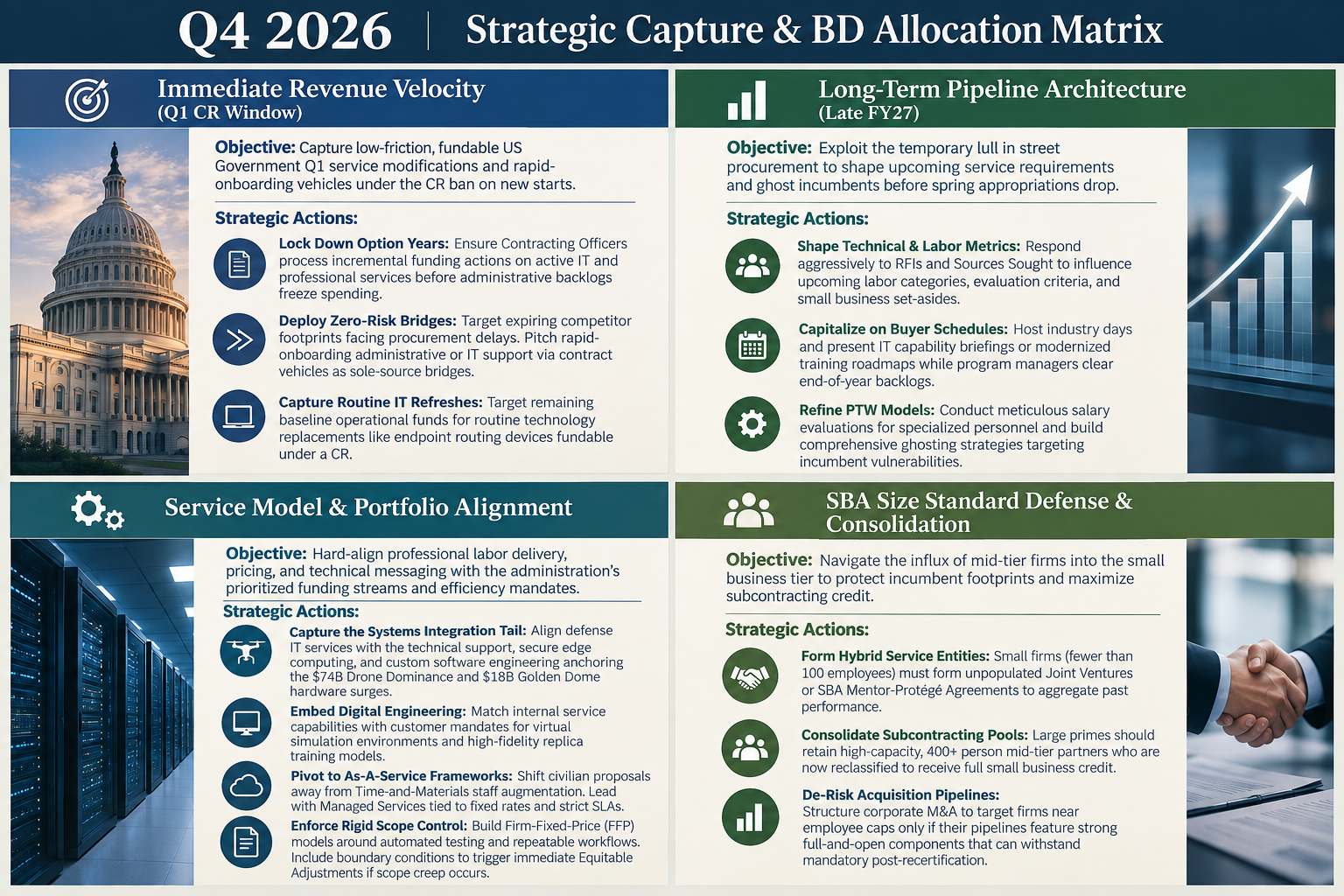
With the new fiscal year launching shortly, the time for strategic planning has closed and the execution phase has begun. In complex, highly regulated, and mission-critical environments, navigating these high-stakes decisions requires absolute precision, credibility, and flawless operational execution. As a leading international business development and transaction advisory services firm, growth[period] specializes in delivering sustainable solutions that improve overall market performance. By partnering with leadership teams and companies through critical fiscal transitions, growth[period] provides the targeted expertise and intelligence required to scale responsibly, adapt under pressure, and unlock long-term contract value.

Turn your FY27 pipeline into an execution plan. Connect with growth[period] via our website at growth[period] to prioritize the opportunities, investments, and actions that will drive the greatest value.

 

growth[period] Announces Lt. Gen. Bill Burleson, US Army (Ret.), as Strategic Client Advisor

Tysons Corner, Virginia – September 9, 2026 – growth[period], a global strategic advisory firm serving public- and private-sector clients, today announced that Lieutenant General Bill Burleson, U.S. Army (ret.), has joined the firm as a Strategic Client Advisor.

General Burleson served more than 36 years in the U.S. Army and brings extensive leadership experience operating in multinational organizations and alliances throughout Asia and Europe. Most recently, he served as the Commanding General of the U.S. Eighth Army in the Republic of Korea (RoK) and Chief of Staff of the RoK-U.S. Combined Forces Command, where he led a multinational organization of more than 40,000 American and Korean military personnel and civilians, managing a security and defense budget that exceeded $341 million. He previously held the role of the Director of Operations for U.S. Forces Korea/Combined Forces Command/United Nations Command in the RoK.

Gen. Burleson also served as Commanding General of the 7th Infantry Division, where he was responsible for the training and readiness of a 17,000-soldier organization oriented on the Pacific Command area of responsibility. Throughout his career, he held a variety of command and staff positions across the Department of Defense, with experience in Egypt, Panama, Bosnia-Hercegovina, Italy, Kosovo, Iraq, and Afghanistan.

As a Strategic Client Advisor for growth[period], Gen. Burleson will bring his extensive military leadership and multinational experience to support the firm and its clients. His background leading complex organizations and working across international alliances will provide valuable perspective as he advises clients navigating evolving challenges.

About growth[period]

For more than 19 years, growth[period]’s management consulting, business development, global risk, and strategy and transaction advisory services have focused on helping companies in highly regulated industries achieve their growth goals. We are nationally recognized as a leading provider to growing and established firms seeking assistance to complete sophisticated corporate and technology transactions; manage entry into the federal government contracting industry; assist with navigating the federal marketplace; represent them in partnering agreements; and advise them on diligence matters. With deep roots globally, growth[period] has more than 90 experts and offices in multiple markets across the United States, Canada, Latin America, Asia and Europe. For more information, please visit www.growthprd.com.


CONTACT

 Talia Frey

703 556 0111

 info@growthprd.com


growth[period] Opens London Practice, Expanding International Advisory Reach

Tysons Corner, Virginia – September 3, 2026 – growth[period], a global strategic advisory firm serving public- and private-sector clients, is pleased to announce the launch of its new practice in London, United Kingdom.

The strategic expansion strengthens growth[period]’s international presence and extends the firm’s strategic advisory capabilities across the UK, Europe, and other global markets, positioning the firm to better support clients in the region while advancing its mission of continued growth.

“London is an exciting next step for growth[period] as we continue to expand our reach and strengthen the way we support clients,” said Courtney B. Spaeth, CEO of growth[period]. “At growth[period], we leverage deep expertise to provide our clients with bespoke solutions to their rapidly evolving challenges. Our London practice allows us to bring that approach closer to the organizations we serve while furthering our efforts to build meaningful relationships internationally.”

The London practice will be supported by growth[period] Senior Advisor Simon Cassey, a specialist in contractual and risk solutions for the international security, defense, and humanitarian sectors with more than 40 years of leadership experience. Cassey has held leadership and directorship roles at leading London brokerages – including Marsh, Sedgwick, Price Forbes, and Fenchurch – as well as senior positions within international security and business intelligence organizations. His expertise spans insurance, finance, law, and certification, with extensive experience developing solutions for organizations operating in high-risk and complex environments around the world.

The launch of the London practice marks another milestone in growth[period]’s trajectory and strengthens the firm’s ability to bring its expertise, relationships, and strategic guidance to clients across international markets.

About growth[period]

For more than 19 years, growth[period]’s management consulting, business development, global risk, strategy and transaction advisory services have focused on helping companies in highly regulated industries achieve their growth goals. We are nationally recognized as a leading provider to growing and established firms seeking assistance to complete sophisticated corporate and technology transactions; manage entry into the federal government contracting industry; assist with navigating the federal marketplace; represent them in partnering agreements; and advise them on diligence matters. With deep roots globally, growth[period] has more than 90 experts and offices in multiple markets across the United States, Canada, Latin America, Asia and Europe. For more information, please visit www.growthprd.com.


CONTACT

 Talia Frey

703 556 0111

 info@growthprd.com


growth[period] Welcomes Chris Detter as a Strategic Client Advisor

Tysons Corner, Virginia – August 20, 2026 – growth[period], a strategic advisory firm serving public- and private-sector clients at moments of growth, complexity, and transformation, today announced that Chris Detter has joined the firm as a Strategic Client Advisor.

Dr. J. Chris Detter is a molecular and microbiologist with more than 25 years of technical and strategic leadership experience spanning global health, agriculture health, biosurveillance, and biosecurity. Dr. Detter provided programmatic and technical guidance to organizations such as Advanced Research Projects Agency for Heath (ARPA-H), SIA Partners, GeneInfoSec, and JumpCode Genomics. Previously, he held leadership roles at Discovery Life Sciences, Illumina, Latham BioPharm Group, and MRIGlobal, where he led multidisciplinary research programs exceeding $30 million annually. He also spent 15 years at the U.S. Department of Energy National Laboratories and served as a Science Advisor and Program Manager for the Defense Threat Reduction Agency, advising senior Department of Defense leadership on biodefense, infectious disease detection, and next-generation sequencing diagnostics.

As a Strategic Client Advisor for growth[period], Dr. Detter will assist clients with solution architecture, program execution management, business case development, and strategic consulting across government, academic, and commercial organizations.

Dr. Detter earned his Ph.D. in Molecular Genetics and Microbiology from the University of Florida and his B.S. in Biology from Baylor University. He holds an active DOD Top Secret clearance and is a certified Contracting Officer’s Representative and Program Manager. The author of more than 100 peer-reviewed publications, he is also the founder and lead organizer of the annual Sequencing, Finishing, and Analysis in the Future (SFAF) Genomic Meeting.

About growth[period]

For more than 19 years, growth[period]’s management consulting, business development, global risk, strategy and transaction advisory services have focused on helping companies in highly regulated industries achieve their growth goals. We are nationally recognized as a leading provider to growing and established firms seeking assistance to complete sophisticated corporate and technology transactions; manage entry into the federal government contracting industry; assist with navigating the federal marketplace; represent them in partnering agreements; and advise them on diligence matters. With deep roots globally, growth[period] has more than 90 experts and offices in multiple markets across the United States, Canada, Latin America, Asia and Europe. For more information, please visit www.growthprd.com.


CONTACT

 Talia Frey

703 556 0111

 info@growthprd.com


growth[period] is Pleased to Announce the Addition of Candice Foley as a Strategic Client Advisor


Tysons Corner, Virginia – July 24, 2026 – growth[period], a strategic advisory firm serving public- and private-sector clients at moments of growth, complexity, and transformation, today announced that Candice Foley has joined the firm as a Strategic Client Advisor.

From 2007 to 2025, Ms. Foley served as a Special Agent for Homeland Security Investigations (HSI), where she was a recognized expert in strategic technology transfer investigations, weapons of mass destruction proliferation networks, U.S. export laws and regulations, and international money laundering, with a practice concentration in violations of the Arms Export Control Act, the International Emergency Economic Powers Act, and the Export Control Reform Act.

In her role as Strategic Client Advisor, Ms. Foley will support growth[period] clients navigating export control compliance, national security, and international regulatory challenges, drawing on her extensive experience advising government and private sector leaders on border security operations, strategic technology interdiction, and counterproliferation measures.

During her tenure at HSI, she led multi-agency international strategic operations targeting illicit supply chains of autonomous weapon systems utilized against U.S. forces and allies, ultimately disrupting adversary procurement of more than 300,000 weapon components. She served as HSI New England’s liaison to the Central Intelligence Agency and as HSI’s appointed representative to the U.S. Department of Justice Strategic Technology Strike Force, and is a two-time recipient of the HSI Executive Director Award for Outstanding Investigative Accomplishment and Emergency Management and the World Customs Organization International Customs Award.

About growth[period]

For more than 19 years, growth[period]’s management consulting, business development, global risk, strategy and transaction advisory services have focused on helping companies in highly regulated industries achieve their growth goals. We are nationally recognized as a leading provider to growing and established firms seeking assistance to complete sophisticated corporate and technology transactions; manage entry into the federal government contracting industry; assist with navigating the federal marketplace; represent them in partnering agreements; and advise them on diligence matters. With deep roots globally, growth[period] has more than 90 experts and offices in multiple markets across the United States, Canada, Latin America, Asia and Europe. For more information, please visit www.growthprd.com.


CONTACT

 Talia Frey

703 556 0111

 info@growthprd.com

growth[period] Announces Addition of Gregory Jaffe as a Strategic Client Advisor

Tysons Corner, Virginia – June 15, 2026 – growth[period], a strategic advisory firm serving public- and private-sector clients at moments of growth, complexity, and transformation, today announced that Gregory Jaffe has joined the firm as a Strategic Client Advisor.

Mr. Jaffe brings extensive experience advising national and international policies and regulations related to agriculture, food, and the environment to growth[period]. In his role as Strategic Client Advisor, he will support clients navigating complex regulatory and policy challenges, leveraging his expertise in sustainability, climate, bioeconomy, biotechnology, biomanufacturing, food safety, pesticides, per- and polyfluoroalkyl substances (PFAS), and food loss waste.

Mr. Jaffe previously served as the Chief Regulatory Officer of the US Department of Agriculture (USDA) and a Senior Advisor to the Secretary. In this role, he managed USDA’s regulatory agenda, coordinated interdepartmental review of significant regulations, and led engagement with the Environmental Protection Agency and Food and Drug Administration on policies affecting USDA programs and stakeholders. He also oversaw and coordinated USDA’s bioeconomy initiatives, investments, and regulatory activities.

Prior to joining USDA, Mr. Jaffe worked at the Center for Science in Public Interest, a nonprofit consumer advocacy organization focused on food and nutrition issues. Mr. Jaffe earned a Bachelor of Arts degree from Wesleyan University and a Juris Doctor from Harvard Law School.

About growth[period]
For more than 19 years, growth[period]’s management consulting, business development, global risk, strategy and transaction advisory services have focused on helping companies in highly regulated industries achieve their growth goals. We are nationally recognized as a leading provider to growing and established firms seeking assistance to complete sophisticated corporate and technology transactions; manage entry into the federal government contracting industry; assist with navigating the federal marketplace; represent them in partnering agreements; and advise them on diligence matters. With deep roots globally, growth[period] has more than 90 experts and offices in multiple markets across the United States, Canada, Latin America, Asia and Europe. For more information, please visit www.growthprd.com.


CONTACT
Talia Frey
703 556 0111
info@growthprd.com


growth[period] Announces the Addition of Andy McCann as a Strategic Client Advisor

Tysons Corner, Virginia – June 10, 2026 – growth[period], a strategic advisory firm serving public- and private-sector clients at moments of growth, complexity, and transformation, today announced that Andy McCann has joined the firm as a Strategic Client Advisor.

Mr. McCann brings more than 35 years of experience in business development, strategic capture, and P&L performance across the information technology and government contracting industries to growth[period]. In his role as Strategic Client Advisor, he will support clients navigating complex federal markets, leveraging his expertise in growth strategy, business development, and market expansion.

Most recently, Mr. McCann served as Senior Vice President for Enterprise at Deep Water Point associates, where he advised clients on navigating complex government contracting markets. Previously, he served as Assistant Vice President for Global Sales at Cognizant, leading a global sales transformation initiative. He also held senior executive leadership positions at EDS, Hewlett Packard, and Dell, where he consistently drove revenue growth, profitability, and business performance. Known for his collaborative and client-focused leadership style, Mr. McCann has a proven track record of driving growth, strengthening client relationships, and delivering measurable results.

Mr. McCann graduated from Elon University and completed advanced studies at London Business School. He is active in the community and has supported organizations including the American Heart Association, the Washington, D.C. Roundtable for the Wounded Warrior Project, and the Brendan Looney Foundation. He is also a past recipient of the FED 100 Award.

About growth[period]

For more than 19 years, growth[period] is a leading international strategic business development and transaction advisory services firm. We specialize in delivering sustainable solutions that improve our clients’ overall market performance. The firm is recognized globally as a leading provider to growing and established clients seeking assistance to complete sophisticated corporate and technology transactions; manage entry into the federal government contracting industry; navigate the federal marketplace; support partnering strategies; and advise on diligence matters. With deep global roots, growth[period] has more than 90 experts and offices across the United States, Canada, Latin America, Asia, and Europe. For more information, please visit www.growthprd.com.


CONTACT

Talia Frey

703 556 0111

info@growthprd.com

growth[period] welcomes Dwayne Lockett as a Strategic Client Advisor

Tyson’s Corner, Virginia – August 7, 2025 – growth[period], a provider of business development and transaction advisory services worldwide, is pleased to announce that Dwayne Lockett has joined the firm as a Strategic Client Advisor. Based out of growth[period]’s Virginia office, Mr. Locket will draw from over 29 years of distinguished federal service spanning the Federal Bureau of Investigation (2012–present), United States Secret Service (2000–2012), United States Army Reserve (2011-2012), and United States Marine Corps (1996–2000) to advise and work with clients on strategic approaches for growth and development.

Lockett currently serves as a Supervisory Special Agent at the FBI, where he provided operational and administrative guidance on complex criminal, counterterrorism, and counterintelligence matters. He is a certified Crisis Management Coordinator, Emotional Intelligence Leadership Instructor, and Adjunct Faculty member for the FBI, with additional expertise in tactical leadership, surveillance, and critical incident response. His prior assignments include serving in the Presidential Protection Division, where he was responsible for devising and executing tactical security plans for high-level domestic and international events. Mr. Lockett is a certified firefighter, HAZMAT responder, and former nationally registered tactical paramedic. He holds a Master of Arts in Intelligence and a Bachelor of Arts in Homeland Security and Emergency & Disaster Management from American Public University and has been recognized with numerous commendations, including the Presidential Support Badge and the Navy and Marine Corps Achievement Medal.

Lockett joins growth[period]’s innovative Strategic Advisory Team, which offers clients experience-based, actionable, and business-focused advice. As an experienced executive, he will help growth[period]’s clients develop and prioritize practical approaches and solutions suited to each client’s unique culture, circumstances, and business development needs. growth[period]’s Strategic Advisory Program supports clients at every stage, whether the client is a high-growth start-up, a late-stage company preparing for a transaction, or a multinational public company. Similarly, the program is intended to support companies ranging from those with no or limited business development resources to those with well-established growth/transaction teams. For more information, visit growth[period] at www.growthprd.com.


About growth[period]

For more than 18 years, growth[period]’s management consulting, business development, strategy and transaction advisory services have focused on serving the principal challenges faced by the federal contractors and commercial businesses hoping to enter the federal marketplace. The firm is nationally recognized as a leading provider to growing and established clients seeking assistance to complete sophisticated corporate and technology transactions; manage entry into the federal government contracting industry; assist with navigating the federal marketplace; represent them in partnering agreements; and/or advise them on diligence matters. With deep roots globally, growth[period] has more than 50 experts and offices in multiple markets across the United States, Canada, Latin America, Asia and Europe. For more information, please visit www.growthprd.com


CONTACT

Talia Frey

703 556 0111

info@growthprd.com

US-Iran Escalation: Global Risk Implications and How to Mitigate Your Organization’s Exposure

March 3, 2026

By Mirriam-Grace MacIntyre, Senior Partner, Global Geopolitical Risk Management

The Situation:

The United States and Israel on February 28 launched waves of attacks on Iran, killing Supreme Leader Ayatollah Ali Khamenei and senior leaders of the Iranian regime. Iran responded swiftly, launching missile and drone strikes against U.S. bases in several Gulf countries, striking civilian infrastructure and oil refineries, and shuttering flights through some of the world’s busiest airports. Iranian-backed armed groups throughout the region also began to react, most notably with Hezbollah in Lebanon launching rockets into Israel.

No quick end is in sight. The President and Israeli government encouraged Iranians to take over their government, but thus far, after 2,000 U.S. and Israeli strikes, the Iranian regime appears to maintain control of the government. The President acknowledged on Monday that military operations were projected to continue for 4-5 weeks, but the U.S. had the ability to continue operations much longer. He later announced the deployment of additional troops and fighter jets to the region.

Immediate Effects:

  • With the Strait of Hormuz effectively closed to maritime traffic, approximately 10% of global maritime traffic and 20% of global oil and liquefied natural gas is blocked from leaving the region. The effects are already being felt in energy markets. Qatar announced it would halt liquefied natural gas shipments after an attack on QatarEnergy, and the price of brent crude rose nearly 10% following attacks on three oil tankers over the weekend. Oil and energy costs will continue to rise, impacting consumers, affecting airline and freight costs, and introducing pricing volatility on longer-term contracts. Some US LNG companies are seeking to fill the gap and Secretary of State Marco Rubio announced the Administration would begin rolling out a plan to address concerns about rising oil prices.
  • Multiple insurance companies issued war-risk cancellations on maritime insurance effective March 5 while terms and premiums can be reissued, resulting in further delays to delivery timelines and threatening failures to meet terms of service-level agreements. As the conflict drags on, we can expect to see more inventory consumed and more invocations of force majeure claims to insurance companies.
  • Dubai, Doha, and Abu Dhabi airports were forced to shutter in recent days, resulting in over 4,000 canceled flights that stranded passengers and flight crews, disrupted air freight across pharmaceutical and electronics industries, and required airlines to take longer, costlier flight routes.
  • Companies operating in the region have encouraged their staff to work remotely; however, if tensions continue, ensuring workforce safety will become increasingly important.
  • Amazon reported outages after two data centers in the United Arab Emirates and a facility in Bahrain were struck by Iranian drones, causing data and service outages in the affected regions.

What Companies Should Do Now:

  • Test Company Scenarios: Companies should evaluate business strategies, supply chains, dependencies, and financial models across a range of potential scenarios, ranging from a short and limited regional crisis to a prolonged, cross-regional conflict.
  • Map supply chain exposure: Companies should map their Tier 1 and 2 suppliers transiting through the Straits of Hormuz or through logistics hubs in the Middle East. Executives should prioritize rebooking critical shipments, shift logistics transport through secondary pre-conflict, and adjust delivery timelines.
  • Review Insurance Coverage: Legal departments should review terms of agreement, war-risk cancellation causes, force majeure triggers and required notices, ensuring relevant documentation is prepared.
  • Establish Crisis Inventory Planning and Policies: Companies should plan for delays in deliveries of critical components and implement crisis plans, which should include pre-positioning spare components at operational locations as well as tracking and rationing use, as necessary.
  • Plan for Rising Energy Costs: Companies should evaluate their financial posture in the face of rising energy costs. This should include ensuring pricing tracks against real benchmarks, activating surcharges early, or negotiating new pricing caps or indexed formulas.
  • Bolster Physical and Cyber Security Programs: Heightened tensions increase the physical and cyber risks to companies. The Director of National Intelligence’s 2025 Annual Threat Assessment noted that Iran’s growing expertise and willingness to conduct cyber operations make it a major threat to the security of U.S. and allied partner networks and data. Companies should anticipate and implement heightened physical and cybersecurity plans for facilities and networks and should monitor for disinformation aimed at causing reputational damage to a company.
  • Implement Security Plans for Affected Staff: As the conflict widens, companies should ensure workforce communication plans are updated, safety guidance is issued, and medical evacuation plans are in order.


Mirriam-Grace MacIntyre is the Senior Partner for Global Geopolitical Risk Management at growth[period], where she advises clients on business market expansion and global risk management strategies. Ms. MacIntyre is a distinguished national security leader with over two decades of experience in intelligence, counterintelligence, and global security operations. She previously served as Executive Director of the National Counterintelligence and Security Center, where she led the U.S. government’s top counterintelligence and security programs, and also served as the Director for Counterintelligence at the White House National Security Council.


growth[period] Announces the Addition of Howie Lind as a Strategic Client Advisor

Tysons Corner, Virginia – February 25, 2026 – growth[period], a strategic advisory firm serving public- and private-sector clients at moments of growth, complexity, and transformation, today announced that Howie Lind has joined the firm as a Strategic Client Advisor.

Mr. Lind brings more than two decades of senior military, government, and corporate leadership experience to growth[period]. In his role as Strategic Client Advisor, he will support clients navigating the defense and federal markets, leveraging his deep understanding of Department of Defense, legislative processes, and high-level stakeholder engagement.

“I am excited about the potential for Howie to help drive transformation for so many of our clients. Howie brings a wealth of experience and expertise and I am thrilled to have him join the team” said Darryle Conway, President of Global Defense at growth[period].

Mr. Lind served 20 years on active duty in the United States Navy as a Surface Warfare Officer aboard five surface combatants, retiring at the rank of Commander. Following his military career, Mr. Lind served as a Senior Director for Government Relations and Business Development at Fluor Corporation in Washington, DC, where he advised on complex federal initiatives and supported strategic growth efforts. He was also a Department of Defense appointee during the Bush Administration, supporting U.S. operations in Iraq and Afghanistan from 2003 to 2007, including serving as a Legislative Liaison for Iraq Reconstruction and contributing to infrastructure development efforts.

In addition to his government and corporate leadership roles, Mr. Lind has served as President of the International Stability Operations Association and has been a corporate consultant to the Department of Defense. He is widely respected for his ability to guide complex legislative initiatives, build trusted relationships at the highest levels of government and industry, and consistently deliver results. He was also a candidate for the U.S. Senate and Congress in 2013–2014. Mr. Lind holds a Bachelor of Science in Statistics from Virginia Tech and a Master of Science in Information Systems from the Naval Postgraduate School.

About growth[period]
For more than 19 years, growth[period] is a leading international strategic business development and transaction advisory services firm. We specialize in delivering sustainable solutions that improve our clients’ overall market performance. The firm is recognized globally as a leading provider to growing and established clients seeking assistance to complete sophisticated corporate and technology transactions; manage entry into the federal government contracting industry; navigate the federal marketplace; support partnering strategies; and advise on diligence matters. With deep global roots, growth[period] has more than 90 experts and offices across the United States, Canada, Latin America, Asia, and Europe. For more information, please visit www.growthprd.com.


CONTACT
Talia Frey
703 556 0111
info@growthprd.com

Hi there!
How can we help you succeed?