
by Dave Doherty, growth[period] Strategic Client Advisor
As the final days of the calendar year approach, federal business development and capture teams confront a high-friction procurement window. On September 29, the traditional start of the calendar year’s fourth quarter (Q4 CY) is just two days away. However, in the context of federal contracting, this calendar milestone aligns with the absolute opening frame of the US Government Fiscal Year 2027 (FY27), which commences on October 1.
Navigating this overlapping timeline requires strict operational precision because the pipeline seen on paper rarely matches the contractual realities on the street. The start of the government fiscal year is almost universally constrained by a Continuing Resolution (CR). For a business development professional, a CR creates an immediate disconnect between high-value procurement targets and achievable contract signings. Because a CR imposes a strict statutory ban on new starts and caps spending at prior-year levels, it heavily restricts what is actually winnable during the final three months of the calendar year that span from October through December.
Crucially, this first-quarter fiscal slowdown does not mean the capture process stops. Instead of a period of inactive stagnation, Q4 CY provides contractors with a unique operational window to deliberately structure and advance their capture activities for the significantly larger opportunities slated to drop during federal Q2 through Q4 (January through September 2027), once formal agency budgets are firmly established. To maximize the long-term return on capture investment, teams must ruthlessly triage their pipelines on September 29. Success requires separating near-term tactical wins from proactive pipeline architecture, shifting core business development energy toward shaping upcoming unrestricted requirements rather than burning vital bid and proposal (B&P) capital on delayed, fluid opening-quarter awards.
On September 29, an unvetted pipeline often features a mix of new-start requirements, major hardware upgrades, and legacy recompetes scheduled for Q1 FY27 award. Under a Continuing Resolution, this pipeline must be heavily discounted because federal program managers are legally barred from initiating net-new program offices or competing new capabilities.
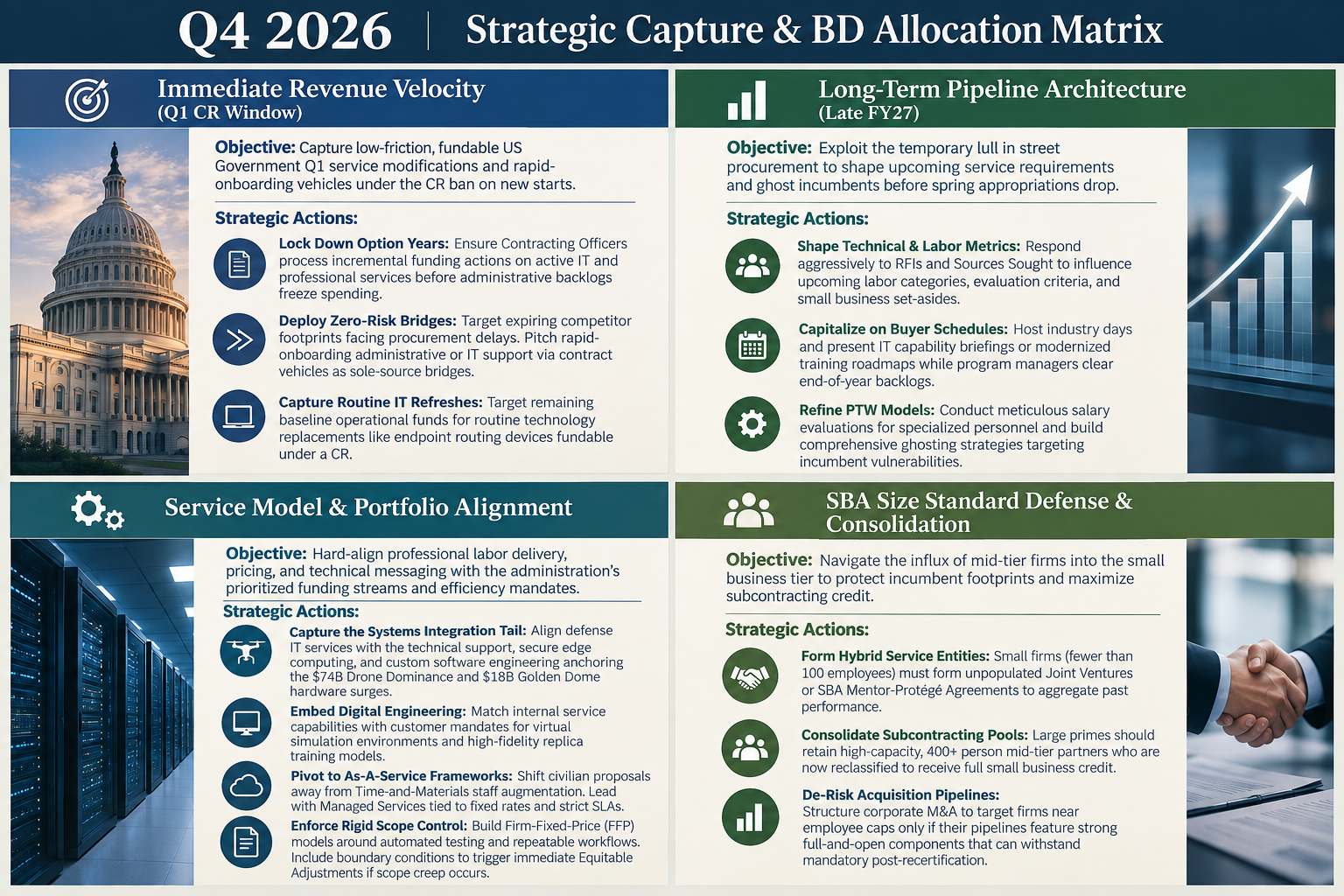
This operational reality dramatically narrows the definition of an immediately winnable opportunity between October 1 and December 31. Capture execution during this final calendar quarter must focus exclusively on option year modifications, emergency bridge contracts, and urgent component replacements. The most immediate source of revenue velocity is the seamless execution of option periods on performing service vehicles. While legally fundable under a CR, administrative friction frequently delays processing, meaning capture teams must work with active program managers to verify that customer Contracting Officers process incremental funding actions before end-of-year administrative backlogs freeze agency spending pools. Concurrently, procurement lifecycles routinely slip as agencies wrestle with CR resource limits. If a competitor holds an expiring contract and the follow-on vehicle faces administrative delays, the customer faces an operational gap. Capture managers must target these expiring competitor footprints, presenting rapid-onboarding service capabilities or pre-vetted General Services Administration Multiple Award Schedule vehicles as zero-risk, sole-source bridge mechanisms. Finally, while major platform rollouts are frozen, routine hardware replenishment remains winnable. If an agency requires basic technology replacements – such as endpoint routing devices or field-level communication spares – to sustain active operations, Contracting Officers can execute these tasks using remaining baseline operational funds.
Rather than treating the first quarter as a revenue baseline, high-performing capture teams utilize this period of legislative friction to position for the major spending releases that occur later in the federal fiscal year. When Congress eventually passes a full appropriations bill – typically in the spring – agencies experience an immediate cash release that forces program offices to compress 12 months of planned spending into a single two-to-three-quarter window.
Maintaining an active, continuous capture posture during Q4 CY allows contractors to shape requirements well before formal requests for proposals (RFPs) drop. While new defense systems or civilian cloud integrations are frozen in Q1 FY27, program offices use this exact period to conduct market research. Capture teams can exploit this window by responding aggressively to Requests for Information (RFIs) and Sources Sought notices, directly shaping the technical evaluation criteria, labor categories, and small business set-aside structures of late-FY27 vehicles before they go to open competition.
Furthermore, using a CR window to target late-FY27 lines gives capture managers the luxury of time to build exhaustive ghosting strategies against incumbent vulnerabilities, conduct meticulous salary evaluations for specialized personnel, and refine Price-to-Win (PTW) models to survive aggressive Firm-Fixed-Price evaluations. This period also provides an ideal climate for customer touchpoint cultivation. During the high-velocity Q4 federal fiscal year sprint from July through September, government buyers and program managers are entirely inaccessible, consumed by end-of-year obligating rushes. The opening quarter of the federal fiscal year represents the exact window when customer touchpoints clear, giving program managers the bandwidth to host industry days, accept capability briefings, and discuss long-term modernization roadmaps.
When assessing targets on September 29, capture teams must validate that their active pursuits map directly to the specific technology products and specialized service segments favored in the administration’s budget submissions. Within the Department of War (DoW), the administration’s defense request centers on high-volume hardware procurement, explicitly anchored by two signature capability lines. The first is autonomous fleet operations and unmanned systems, backed by a $74 billion Drone Dominance initiative funding the immediate acquisition of commercial off-the-shelf small unmanned aerial systems, autonomous undersea vehicles, and ruggedized ground robotics.
The second is space resiliency and missile defense, backed by an $18 billion Golden Dome architecture allocation directly targeting the procurement of low-Earth orbit sensor satellites, next-generation telemetry hardware, and hardened ground-station communication receivers. For service-focused providers, these product investments create an extensive systems integration tail. Official policy directives emphasize that the military cannot operationalize these standalone hardware assets without external technical support, meaning capture messaging must shift away from raw platform capabilities to target tactical data link alignment, custom software engineering, secure edge computing, and autonomous piloting integration. Furthermore, pursuit strategies must map to the DoW’s digital engineering mandates, matching internal capabilities with customer requirements for virtual simulation environments and high-fidelity replica modeling.
Conversely, civilian components face compressed top-line allocations that are rapidly eliminating traditional Time-and-Materials staff augmentation models. Official administration guidelines instruct civilian Chief Information Officers to implement structural efficiencies through Managed Services and As-A-Service frameworks. Under this structure, the contractor absorbs the lifecycle risk of the underlying product assets – including enterprise hardware refreshes, endpoint routing devices, and cloud software licensing – while the customer pays a predictable, fixed rate tied directly to enforceable Service Level Agreements. Capture teams targeting civilian portfolios must lead with quantifiable performance metrics, showcasing how legacy application refactoring and automated cloud optimization directly lower long-term Operations and Maintenance outlays.
Federal buyers continue to show an aggressive preference for Firm-Fixed-Price (FFP) contract vehicles over cost-reimbursable models for both product supply and professional labor. Because FFP contract types shift 100% of performance, labor volatility, and material inflation risk onto the awardee, capture and pricing teams must maintain strict internal boundaries. Solution architectures must move away from standard labor-hour estimates toward capability-based pricing models, building cost volumes around automated testing, software accelerators, and highly repeatable workflows to optimize internal labor configurations while protecting the fixed milestone margin.
Additionally, technical responses must include explicit boundary conditions that definitively isolate out-of-scope tasks. Capture teams must design clear change-management procedures directly into the technical narrative to trigger immediate requests for Equitable Adjustment if an agency attempts uncompensated scope creep post-award. Under an FFP structure, rigid scope control replaces labor-hour margins as the primary baseline for contract profitability.
The Small Business Administration’s (SBA’s) proposed consolidation of North American Industry Classification System (NAICS) codes and structural transition from revenue thresholds to employee-count metrics represents a major disruption (for more details, read growth[period]’s Client Impact Brief on the SBA’s proposed overhaul). This policy change will shift over 114,000 mid-tier firms back into the small business category for FY27, completely reconfiguring competitive dynamics across three distinct tiers of the market. Firms with 300 to 500+ employees that previously outgrew revenue caps may find themselves unexpectedly reinstated as small businesses under the new employee-based caps.
These mid-tier firms, if reclassified, will be auditing their active pipelines to target large-scale small business set-asides that were previously off-limits, bringing corporate past performance and deep balance sheets that easily outscore traditional, un-partnered small businesses. To cement this structural advantage, reclassified mid-tiers are actively acquiring niche small businesses that hold specialized socioeconomic entry points, such as 8(a), SDVOSB, or HUBZone designations, allowing the mid-tier to overlay its large-scale execution engine over restrictive vehicles while maintaining small-tier compliance under the updated employee thresholds.
This paradigm will force traditional small businesses with fewer than 100 employees into an acute competitive squeeze to protect their incumbent footprints. Bidding independently as a small prime on complex, high-value set-asides carries a low probability of win in FY27, forcing traditional small firms to build unpopulated, SBA-sanctioned Joint Ventures or enter formal Mentor-Protégé Agreements to aggregate past performance metrics. Partnering directly with a reclassified mid-tier yields a highly competitive hybrid entity that blends small-business agility with large-scale corporate past performance. Concurrently, to protect equity value against an influx of larger competitors, many traditional small business owners are executing exit-driven M&A maneuvers, packaging their firms as immediate acquisition targets for larger integrators seeking quick access to ring-fenced vehicles or specialized, cleared personnel pools.
Large system integrators and Tier-1 primes are also modifying their long-term partner ecosystems to adjust to the proposed new size thresholds. Primes face contractually mandated small business subcontracting goals on major system integrations, and in prior cycles, graduating small businesses were systematically dropped from subcontracting teams to preserve small-business credit. In the proposed changes for FY27, primes can retain these high-capacity, 400-person mid-tier partners while receiving full small business credit, driving a consolidation of subcontracting pools. Concurrently, large businesses are navigating a complex M&A environment where acquiring a newly reclassified small business triggers mandatory contract recertification, which can prematurely strip the target company of its small business status on existing task orders. Large primes are therefore structuring acquisitions to target firms near the top of the employee caps only if their pipelines feature strong full-and-open components that can withstand an immediate transition to the unrestricted tier.
Ultimately, the FY27 federal market will be a turbulent environment that will reward precise capital allocation and rigid risk management. Success belongs to capture teams who secure their baseline revenue during the Q1 CR window, leverage the temporary drop in street procurement to shape upcoming vehicles, and align their pipelines to capture the service tails of the Department of War hardware surge coming down the line.
Your pipeline may be long. Your Q4 resources aren’t. The Q4 2026 Capture & BD Allocation Matrix is designed to force the allocation question: What deserves attention now, what needs to be shaped for later, and where does the business need to reposition? The four areas below provide a framework for deciding where capture and BD effort can have the greatest impact as FY26 closes and FY27 begins.
With the new fiscal year launching shortly, the time for strategic planning has closed and the execution phase has begun. In complex, highly regulated, and mission-critical environments, navigating these high-stakes decisions requires absolute precision, credibility, and flawless operational execution. As a leading international business development and transaction advisory services firm, growth[period] specializes in delivering sustainable solutions that improve overall market performance. By partnering with leadership teams and companies through critical fiscal transitions, growth[period] provides the targeted expertise and intelligence required to scale responsibly, adapt under pressure, and unlock long-term contract value.
Turn your FY27 pipeline into an execution plan. Connect with growth[period] via our website at growth[period] to prioritize the opportunities, investments, and actions that will drive the greatest value.