MacIntyre asserts supply chain security must be treated as a strategic intelligence discipline
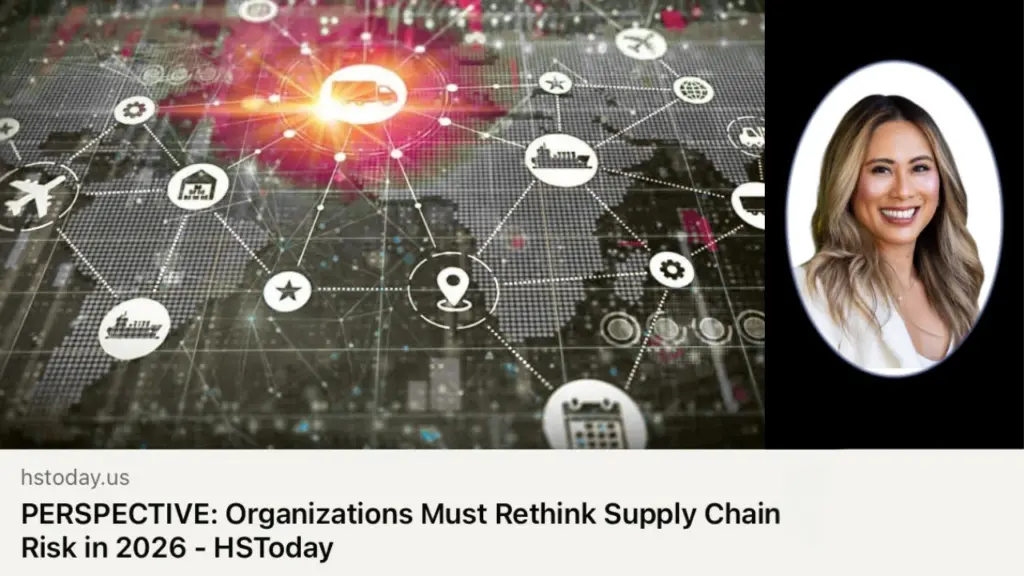
Tysons Corner, Virginia – April 29, 2026 – growth[period], a strategic advisory firm serving public- and private-sector clients at moments of growth, complexity, and transformation, is proud to share that Mirriam-Grace MacIntyre, Senior Partner for Global Risk Management, has been published in Homeland Security Today. Her article, “PERSPECTIVE: Organizations Must Rethink Supply Chain Risk in 2026,” examines the growing imperative for organizations to assess political, economic, and security-related risks across their supply chains, and translate that intelligence into informed decisions and proactive risk mitigation.
In the piece, MacIntyre draws on her experience as former Executive Director of the National Counterintelligence and Security Center and her senior roles at the National Security Council and the Office of the Director of National Intelligence to make the case that supply chain security has become one of the defining strategic challenges of this decade.
Modern supply chains underpin everything from critical infrastructure and defense systems to healthcare delivery and everyday commerce. As global networks grow more interconnected and technology-driven, they also become more exposed to disruption, manipulation, and exploitation. MacIntyre argues that organizations that continue to treat supply chain security as a procurement or compliance function – rather than a strategic intelligence discipline – will find themselves repeatedly surprised by disruptions that were, in retrospect, entirely foreseeable.
The article examines two developments that crystallized these risks in 2026: China’s escalating use of export controls as a tool of economic statecraft, and the cascading market effects of the Iran conflict on global supply chains. MacIntyre highlights the “hidden exposure problem:” — the reality that most organizations have invested in understanding their immediate suppliers while remaining blind to the second- and third-order dependencies where geopolitical shocks actually originate.
“The main challenge is not that organizations don’t have enough information,” MacIntyre writes. “It’s that they are not using the information they have to make decisions that can help avoid problems before they happen.”
The article also addresses the role of artificial intelligence in supply chain risk management, both as a tool for surfacing hidden vulnerabilities and as a source of new supply chain risk in its own right.
MacIntyre concludes that organizations that prioritize supply chain security and translate early warning signals into operational decisions will be best positioned to handle whatever instability comes next.
Click here to read the full article.
About growth[period]
For more than 19 years, growth[period]’s management consulting, business development, global risk, strategy and transaction advisory services have focused on serving the principal challenges faced by companies in highly regulated industries. We are nationally recognized as a leading provider to growing and established firms seeking assistance to complete sophisticated corporate and technology transactions; manage entry into the federal government contracting industry; assist with navigating the federal marketplace; represent them in partnering agreements; and/or advise them on diligence matters. With deep roots globally, growth[period] has more than 90 experts and offices in multiple markets across the United States, Canada, Latin America, Asia and Europe. For more information, please visit www.growthprd.com.
CONTACT
Talia Frey
703 556 0111
info@growthprd.com